
LEED ID+C Certification: A Practical Guide to Sustainable Office and Retail Interiors
For many companies, creating a sustainable workplace does not begin with constructing a building. It begins with leasing an existing space and deciding how it will function. From lighting and air-conditioning to interior materials and furniture, fit-out decisions can influence energy and water consumption, indoor environmental quality, and the workplace experience throughout the lease term.
LEED Interior Design and Construction (LEED ID+C) provides a framework for integrating sustainability into these decisions. Unlike a whole-building certification, LEED ID+C focuses on the interior space that a tenant or owner designs and develops. This allows organisations to pursue measurable sustainability outcomes within the areas they control, even when the base building follows a separate certification pathway.
For businesses planning a new office, retail outlet, or other commercial interior, understanding the rating system early can help align sustainability objectives with design requirements, construction schedules, and budget considerations. This guide explains how LEED ID+C works, what it assesses, how it compares with other certification options in Indonesia, and what project teams should consider before pursuing certification.

What Is LEED ID+C?
LEED ID+C, or Leadership in Energy and Environmental Design: Interior Design and Construction, is a green building rating system developed by the U.S. Green Building Council (USGBC). It is designed for complete interior fit-out projects where the project team is responsible for the design and construction of the interior space rather than the entire building.
While LEED Building Design and Construction (LEED BD+C) addresses whole buildings and major building projects, LEED ID+C enables tenants and owners to assess and improve the environmental performance of their interior spaces.
The rating system includes adaptations for different project types, including:
Commercial Interiors: Offices and other commercial interior spaces.
Retail: Retail stores and related spaces, such as showrooms.
Hospitality: Eligible hospitality interiors and related facilities.
The appropriate adaptation depends on the project's intended use and scope. Before registration, project teams should confirm the applicable rating system and eligibility requirements with USGBC.
Understanding LEED v5
Launched in April 2025, LEED v5 is USGBC's latest version of the rating system. It places greater emphasis on decarbonisation, quality of life, and ecological conservation and restoration, reflecting a broader focus on climate performance and human health.
However, most LEED v4 and v4.1 commercial rating systems, including ID+C, remain open for registration until 30 June 2027. Project teams should assess the applicable requirements and timelines early to determine the most suitable version for their project.
Why LEED ID+C Matters for Tenants in Indonesia
A building's sustainability performance depends on more than its structure and central building systems. The way its interior is designed, equipped, operated, and maintained also influences resource consumption and occupant experience.
For tenants in Indonesia, LEED ID+C provides a framework for addressing these considerations within a leased space. It can also help bridge the gap between a building's existing sustainability credentials and a company's own workplace objectives.
1. Improving operational efficiency
Energy-efficient lighting, equipment, and controls can reduce workplace energy demand. Coordination with building management helps identify feasible measures, particularly for shared HVAC systems.
2. Managing water consumption
Efficient fixtures in pantries and washrooms can reduce water use while maintaining functionality, depending on existing infrastructure and applicable LEED requirements.
3. Making more responsible material choices
LEED-aligned procurement encourages consideration of material impacts, product transparency, emissions, and construction waste. Early planning helps integrate these priorities into specifications and supplier coordination.
4. Supporting healthier interior environments
Ventilation, indoor air quality, lighting, thermal comfort, and acoustics influence workplace comfort. LEED ID+C provides a framework for addressing these factors through appropriate design measures.
5. Demonstrating progress on corporate sustainability commitments
LEED certification provides third-party evidence of a project's environmental performance, supporting sustainability reporting and corporate real estate standards. However, it complements rather than replaces a company's broader ESG efforts.
Ultimately, the value of LEED ID+C lies in connecting sustainability objectives with decisions that project teams can influence directly.
What Does LEED ID+C Assess?
LEED ID+C combines mandatory prerequisites with optional credits. Projects must meet the applicable prerequisites and earn sufficient points through eligible credits to achieve certification.
The exact requirements, credit names, and available points vary by version and adaptation. The areas below provide a general overview of considerations relevant to interior fit-out projects rather than a definitive scorecard.

Under LEED v5, decarbonisation receives greater emphasis, with requirements and pathways that may differ from earlier versions. Project teams should use the official reference guide and scorecard for the version under which they intend to register.
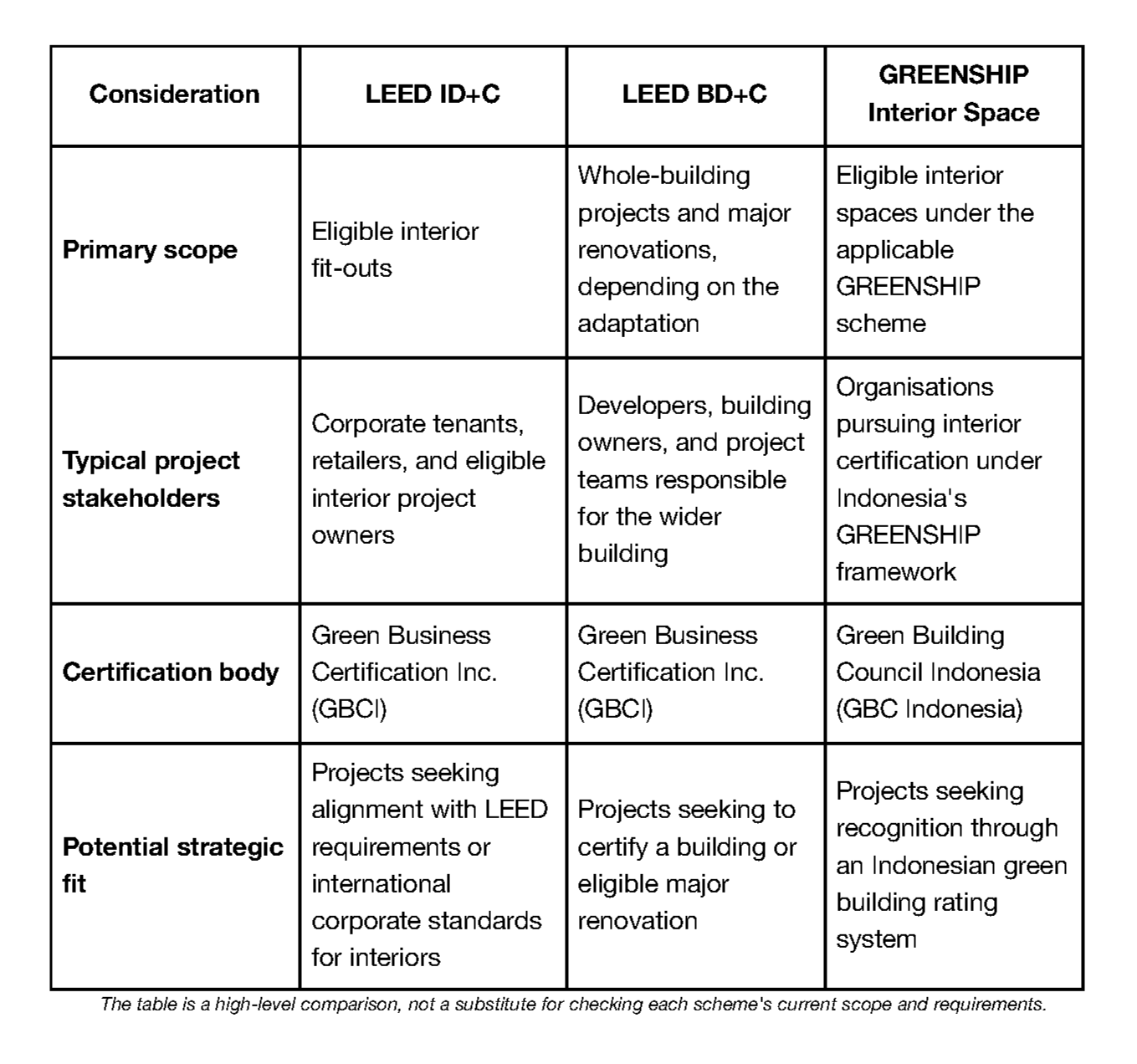
LEED ID+C, LEED BD+C or GREENSHIP Interior Space?
Choosing a certification pathway begins with understanding the project's scope and objectives. A tenant fit-out inside an existing office tower is different from a development that includes the building itself, while a locally focused certification strategy may have different priorities from one driven by international corporate standards.
Three options worth considering are LEED ID+C, LEED BD+C, and GREENSHIP Interior Space.
When should a tenant consider LEED ID+C?
LEED ID+C suits companies managing their own interior fit-outs, particularly those with global sustainability standards or LEED requirements. While the base building does not need LEED certification, access to building data and cooperation from management can affect compliance.
When should a project consider GREENSHIP Interior Space?
GREENSHIP Interior Space may suit organisations seeking certification under Indonesia's green building framework. Compare each system's requirements, fees, documentation, and certification objectives before deciding, rather than assuming one is automatically cheaper or easier.
Confirming eligibility before registration
Confirm the project's scope and eligibility before selecting a rating system. For LEED ID+C, review the applicable version's requirements, particularly if the project involves changes to the building structure, façade, or base building systems. Consult USGBC guidance before registration if the appropriate pathway is unclear.
How the LEED ID+C Certification Process Works
LEED certification is most effective when integrated into the fit-out programme from the beginning. Waiting until construction is underway can make it harder to incorporate design measures, obtain information from suppliers, and collect the evidence required for review.
A typical process includes the following stages:
Step 1: Establish project objectives and feasibility
Define the project scope, certification goals, budget, and timeline. Review existing building certifications, available data, and the tenant's control over relevant systems to confirm the appropriate LEED pathway and version.
Step 2: Develop the certification strategy
Assess applicable prerequisites and credits, set a realistic target, and assign responsibilities across the project team. Use a preliminary scorecard to guide planning, not as a guarantee of the final result.
Step 3: Integrate requirements into the design
Incorporate certification requirements into interior layouts, lighting, MEP systems, materials, and procurement specifications. Early integration helps minimise late changes and manage costs.
Step 4: Implement measures and collect documentation
During construction, implement the agreed measures and gather supporting evidence, such as product data, calculations, waste records, and commissioning reports. Clearly assign documentation responsibilities to the relevant stakeholders.
Step 5: Submit the application for review
Submit the required documentation to the certification body for assessment. Additional clarification may be requested, and the final outcome depends on compliance with the applicable requirements and the review process.
What Are the LEED Certification Levels?
LEED projects can achieve one of four certification levels based on the points awarded after review.

These thresholds reflect the standard LEED 110-point scale; project teams should confirm the applicable requirements for their selected rating system and version.
For corporate offices and retail interiors, the certification target should reflect the organisation's objectives, project feasibility, and stakeholder requirements. While some projects may target Gold, others may prioritise achievable, measurable improvements.
A higher rating is not always the best choice. Consider the design, building systems, budget, timeline, and available documentation, along with any additional mandatory requirements under the selected LEED version.
How Much Does LEED ID+C Cost, and What Is the Business Case?
The cost of LEED ID+C varies by project. It depends on the selected version and adaptation, certification target, project size and complexity, consultant involvement, building conditions, and the measures required to meet the applicable criteria.
Rather than relying on a single benchmark, project teams should develop a project-specific estimate before committing to certification.
Typical cost components
GBCI registration and certification review fees
Sustainability consultant fees for strategy, coordination and documentation
Commissioning and, where needed, energy modelling or calculations
Any premium for higher-specification equipment, fixtures or materials
Typical returns
Lower energy and water bills across the lease term
A healthier, more attractive workplace for current and prospective employees
Compliance with corporate real estate standards and ESG commitments
Better coordination between design, procurement and construction teams
A recognised, third-party outcome to communicate to stakeholders
The balance depends on the base building, landlord cooperation, specifications and target level. A short feasibility assessment at the start gives a clear view of expected cost, schedule and benefits before any commitment.
Sustainahaus Experience in Sustainable Interiors
Sustainahaus supports organisations pursuing green building certification for interior spaces, helping translate certification requirements into practical actions across design, construction, and documentation.
Our experience includes corporate and retail interiors in Jakarta that have achieved Gold-level certification under LEED ID+C and GREENSHIP Interior Space.
LEED ID+C Gold
Global financial institution office, Sequis Tower
Corporate office, Jakarta Mori Tower: a tenant fit-out in a tower that already holds Green Mark Platinum and WELL Core Gold. It shows how an interior certification can build on a high-performing base building.
Shiseido store at Plaza Indonesia and
A new office at WTC 3.
GREENSHIP Interior Space Gold
MSIG office, Summitmas Tower
MSIG Life office, Sinarmas MSIG Tower
Shiseido office, World Trade Center
Across interior projects, our approach focuses on establishing the appropriate certification pathway early, coordinating with the interior designer, MEP engineers, contractor, and other stakeholders, and managing the technical documentation needed throughout the process.
This helps clients integrate sustainability requirements into project delivery while maintaining visibility over responsibilities, constraints, and certification objectives.
With a LEED AP team and experience spanning more than 90 projects across eight or more APAC countries, Sustainahaus combines international green building frameworks with an understanding of local project conditions.
Plan Your LEED ID+C Project with Sustainahaus
Whether you are relocating your headquarters, opening a flagship store, or renovating an existing office, the best time to plan for certification is before design begins.
Sustainahaus can support you by:
Assessing whether LEED ID+C, GREENSHIP Interior Space or another standard best fits your goals
Setting a realistic certification target and budget
Integrating requirements into design, procurement and construction
Managing documentation and submission through to certification
Planning a new office or retail fit-out? Contact Sustainahaus to discuss your project and find a practical pathway to certification.
Frequently Asked Questions
What is the difference between LEED ID+C and LEED BD+C?
LEED ID+C certifies a complete interior fit-out, such as a tenant's office or store. LEED BD+C certifies a whole building or major renovation, usually pursued by the developer or owner.
Can my office get LEED certified if the building is not LEED certified?
Yes. LEED ID+C certifies the tenant's space, so the base building does not need its own LEED certification. A certified base building can, however, make some credits easier to achieve.
How long does LEED ID+C certification take?
The process runs alongside design and construction. Final review typically follows completion and handover, so starting at concept design keeps certification from delaying occupancy.
Which LEED version applies to new projects?
LEED v5, launched by USGBC in April 2025, is the current version for new registrations. Confirm the applicable version when you register.
Is GREENSHIP Interior Space an alternative?
Yes. GBC Indonesia's GREENSHIP Interior Space is the local equivalent and can suit domestic companies. Multinationals with global LEED standards generally choose LEED ID+C.
References
U.S. Green Building Council — LEED for Interior Design and Construction
U.S. Green Building Council — LEED v5
U.S. Green Building Council — LEED Rating System Selection Guidance
Green Building Council Indonesia — GREENSHIP rating tools
Requirements change between LEED versions. Always confirm the applicable version and rating system when planning a project.
