How to Measure Carbon Emissions: GHG Protocol Explained – Scope 2
The GHG Protocol’s Corporate Standard outlines the set of accounting and reporting rules that identify and categorise emissions from all corporate operations. This standard requires the company to create an emissions inventory of energy generation and consumption, including electricity, steam, heat, and cooling (most often collectively referred to as “electricity”). These emissions are termed as ‘Scope 2’ and considered an indirect emissions source (along with Scope 3), since they are a consequence of activities of the reporting company but actually occur at sources owned and controlled by another organisation (assuming the power plants are different from the reporting company). Scope 2 constitutes a major source of global GHG emissions, where electricity itself accounts for 25% of total global emissions (Brander et al., 2018).
How to Calculate Scope 2 Emissions
Scope 2 emissions capture the emissions from the generation of electricity that is purchased and acquired by the company. They do not include emissions from transmission and distribution losses or upstream life-cycle emissions of the technology used in generation. If electricity is purchased for resale, the associated emissions are not reported under Scope 2. Two accounting approaches are used to determine the emission factor for Scope 2 emissions:
1. Location-based Method
The emission factor reflects the average emission intensity of the electricity grid in a defined location where consumption occurs. This can be determined based on local, subnational, or national boundaries.
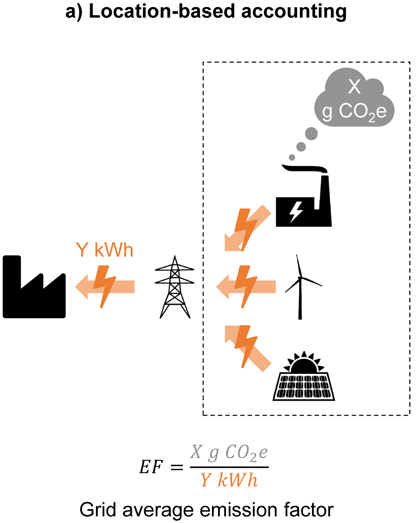
Source: Schaffer et al. (2024)
Total GHG Emissions = kWh of electricity used x EF of local grid
2. Market-based Method
The market-based method only applies in markets where consumers can choose which electricity product to purchase. The company may purchase electricity bundled with contractual instruments or as its own. This method captures emissions based on the factors presented in associated contractual instruments. The aforementioned contractual instruments —ordered from the highest to lowest precision— include: energy attribute certificates, direct contracts, supplier-specific emission rates, and other default emission factors representing the untracked or unclaimed energy and emissions (residual mix).
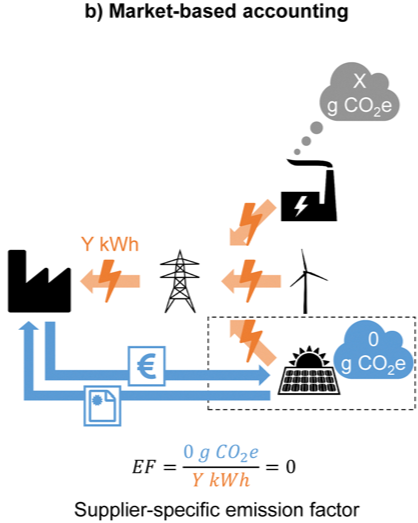
Source: Schaffer et. al (2024)
Total GHG Emissions = kWh of electricity used x EF of contractual source
What About Renewable Energy?
When a company purchases renewable energy, it should not be treated as "reduced” or “avoided” emissions. Instead, under the market-based method, it may be accounted for as zero emissions if supported by valid contractual instruments. In several countries, zero-emission claims can be made by purchasing Energy Attribute Certificates (EACs), provided they meet recognised quality criteria. Most energy grids supply power with a blend of different energy facilities. Although consumers cannot control the specific electrons they receive at any given time, EACs separate the environmental attributes of renewable generation from the physical electricity delivered through the grid. When properly applied under the market-based method, these instruments allow companies to report zero Scope 2 emissions for the portion of electricity covered by eligible certificates. However, companies must ensure certificates meet quality criteria, including additionality, uniqueness, and geographic relevance.
Energy derived from biogenic materials —such as biomass pellets, biofuels, and biogas— can be less GHG-intensive than fossil fuels. However, their utilisation still produces GHG emissions and therefore should not be considered zero-emission energy. Under the GHG Protocol, methane (CH₄) and nitrous oxide (N₂O) emissions from biogenic energy consumption are reported within Scope 2, while biogenic CO₂ emissions are disclosed separately, outside the three scopes. Location-based emission factors usually do not state the percentage of biomass, so they cannot be used to distinguish biogenic emissions. Companies should therefore transparently disclose whether the emission factors applied include or exclude biogenic components.
In general, there are 3 ways in which a company’s decisions influence its Scope 2 emissions:
1. Facility and operation site
The carbon intensity of the electricity grid where a facility operates directly affects its Scope 2 emissions. Establishing operations in regions with carbon-intensive grids results in higher emissions, whereas locations with lower-carbon electricity mixes —or natural advantages such as favourable climate conditions for cooling or heating— can significantly reduce a company’s emission profile.
2. Level and timing of electricity demand
Companies can reduce Scope 2 emissions by lowering overall electricity consumption through energy-efficient buildings, efficient equipment, and behavioural changes. Smart grid information and systems allow consumers to plan equipment use timing for optimal times of day (low-cost or non-peak times).
3. Influence grid mix
Electricity consumers can send market signals to support low-carbon energy, such as by developing on-site low-carbon energy projects, entering direct contracts with low-carbon suppliers, negotiating with suppliers to provide low-carbon energy for the company, and purchasing certificates from low-carbon suppliers. Aggregate consumer decisions or a large corporate consumer representing a huge portion of electricity consumers are required to change a grid’s mix over time significantly.
Calculating Scope 2 along with Scope 1 emissions helps companies to pinpoint hotspots and low-hanging fruit for reducing their carbon footprints over time. These two scopes are typically easier to manage than Scope 3 emissions as they are more directly influenced by companies’ decisions. For an overview of Scope 1 emissions, read our previous article here.