Passive Design: How Does It Affect User Experience and Energy Savings?
Introduction: The 3-Tier Approach to Sustainable Design
What makes a building “green”? Most of the time, people assume that planting trees or installing solar panels will turn a building into a “green building”. Although this is partially true, a green building often starts with much simpler design decisions, such as the position of windows, the shape of the roof, and the orientation of the walls. This is what we call in architecture “passive design”, and it is the foundation of a sustainable or green building design.
Professor Norbert Lechner (2015) explained this through his development of the famous pyramid of the 3-tier approach to sustainable design:
Tier 1 - Basic building design
Tier 2 - Passive systems
Tier 3 - Mechanical equipment, also called “active systems”
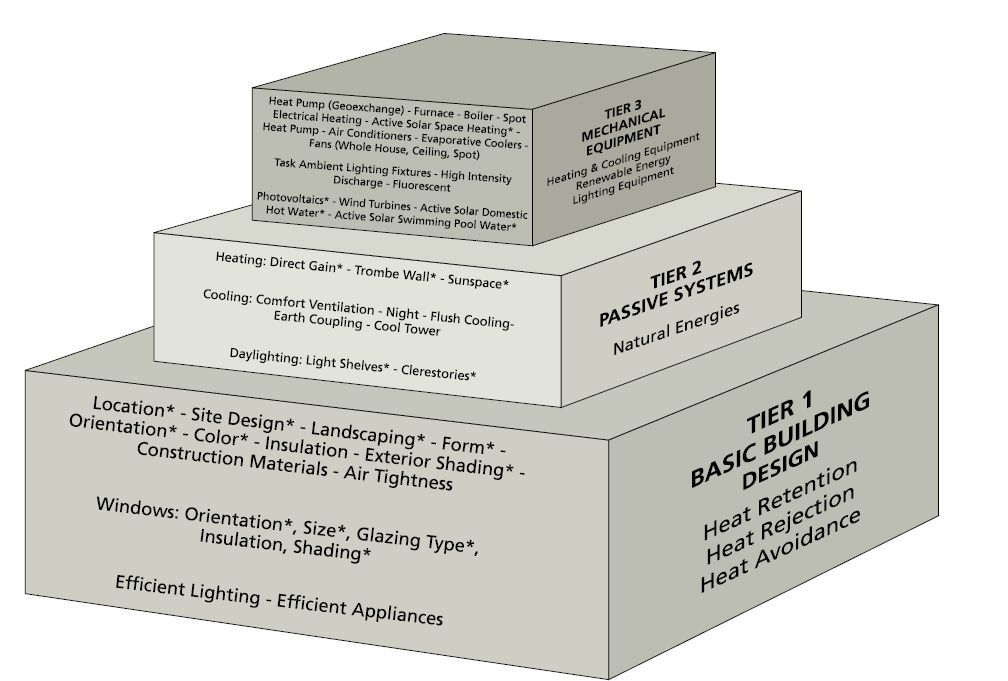
Source: Lechner, N. (2015). Heating, cooling, lighting: Sustainable design methods for architects. John Wiley & Sons.
All three tiers are required to achieve the optimal efficiency in a building; however, in most cases, only tier 3 is used to address building efficiency issues, such as installing solar panels or other renewable energy sources. In practice, according to Lechner, if the basic building design is modified optimally, the energy requirements of mechanical systems such as air conditioning, heating, and lighting (tier 3: active systems) can be reduced drastically to only around 15% of the typical demand.
This means that directly focusing on tier 3 is actually less efficient, as more energy needs to be supplied by renewable installations or equipment with higher specifications, which also results in higher construction costs. The primary focus of sustainable building should be on reducing the amount of energy required to operate the building at the design level before using other mechanical measures.
The Role of Architecture in Designing for Comfort
Before diving deeper into the 3-tier approach of sustainable design, it is important to understand that architecture’s main role is to create spaces that fulfil 3 aspects of the occupants’ needs: function, comfort, and aesthetics. Sustainable design is a great contributor to fulfilling the comfort aspect. Although comfort may be different for each individual, it is actually measurable to some extent and can be identified through several categories, such as:
Thermal comfort
Indoor air quality
Visual comfort
Acoustic comfort
These categories are related to each other and highly determined by the environment and context in which the spaces are located. Thus, when designing a space, one should focus not only on its physical elements of a space but also consider its surrounding environment. Sustainable design should be able to integrate a space with its built environment.
The quality of the built environment directly affects how occupants experience and interact with a space on a daily basis. Several studies have shown that environmental quality is directly related to human performance and well-being. Research conducted by AHMM’s Craig Robertson and Ines Idzikowski Perez of UCL (2016) has shown that when indoor temperatures are compared to a “productive” fixed threshold (based on Seppänen’s model), overheating leads to an estimated productivity loss of 10% to 20%. After applying passive strategies, the building’s improved case reduces this to an average productivity loss of about 8%.
Similarly, Harvard research (Allen et al., 2016) found that better indoor air quality can improve cognitive function scores by up to 61%. The World Health Organization (WHO) also confirms that poor indoor environments can contribute to fatigue, headaches, respiratory illness, and reduced well-being.
Passive Before Active
So how do we achieve comfort through sustainable design?
All categories of comfort must be considered when designing for sustainability, including climate and context. For example, we might think that placing smaller windows is better in order to transfer less heat inside during summer and lose less heat during winter. While this strategy may be more appropriate for colder regions, it is less suitable for hot and humid tropical climates. For tropical climates, larger windows are generally preferred and placed along the direction of the prevailing wind. Another smaller one at the opposite end, placed at a higher position, will allow the wind to flow through the space and let the hot air, which has less density than cold air, escape, creating what is called “natural cross ventilation”.
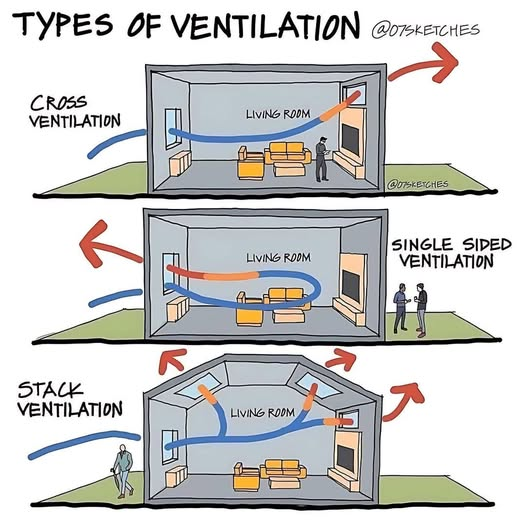
Source: Archmili (2024).
Several problems may arise from this strategy, such as noise and glare, which can lead to acoustic and visual discomfort. Within the basic and passive design approach, glare can be reduced by installing shading devices, such as overhangs or fins on the walls surrounding the windows, to divert sunlight from directly hitting the windows, as well as through operable windows that allow occupants to adjust the intensity of daylight according to their needs. Likewise, noise can be reduced through the use of double glazing and the planting of sound-blocking vegetation.
Only when all the basic building design and passive systems have been applied, and the level of comfort has not yet been achieved (realistically, in most cases), should we resort to utilising mechanical equipment, or “active systems”, such as air conditioning and artificial lighting. If the spaces are not properly ventilated and lit through basic design and passive systems, more HVAC and lighting equipment with higher specifications would be required, and more energy would be needed to operate it, potentially necessitating support from renewables to balance energy demand.
This shows that relying on active systems alone is less energy-efficient, as higher energy demand must be met by renewables. Therefore, all cooling, heating, and lighting requirements should primarily be accommodated at the basic design and passive system phases. Passive strategies aim to reduce energy demand, while active systems are intended to fulfil the remaining operational needs efficiently.
Conclusion: Designing Beyond Efficiency
In conclusion, passive design is very important in reducing energy use and improving indoor comfort through basic design and the use of passive systems. Sustainability should start from the design stage, where buildings are designed in context to their environment instead of depending mainly on active mechanical systems.
Although comfort is subjective and varies from person to person, green building design aims to create conditions that are comfortable for most users within an acceptable range. Research shows that better environmental quality can improve productivity and well-being, indicating that passive design is not only about saving energy but also about improving how people experience a space in everyday life.
References
Lechner, N. (2015). Heating, cooling, lighting: Sustainable design methods for architects. John Wiley & Sons.
Auburn University. (n.d.). Sustainability in action: Norbert Lechner. https://sustain.auburn.edu/sustainability-in-action-norbert-lechner/.
Robertson, C., & Idzikowski Perez, I. (2016, September). In control – thermal comfort and productivity. CIBSE Journal. https://www.cibsejournal.com/case-studies/in-control-thermal-comfort-and-productivity/
World Green Building Council. (2016). Health, wellbeing and productivity in offices: The next chapter for green building. https://worldgbc.org/wp-content/uploads/2022/03/WorldGBC-Health-Wellbeing-Framework_Exec-Report_FINAL.pdf.
Allen, J. G., MacNaughton, P., Satish, U., Santanam, S., Vallarino, J., & Spengler, J. D. (2016). Associations of cognitive function scores with carbon dioxide, ventilation, and volatile organic compound exposures in office workers: A controlled exposure study of green and conventional office environments. Environmental Health Perspectives, 124(6), 805–812. https://doi.org/10.1289/ehp.1510037.
World Health Organization. (2018). Environmental noise guidelines for the European region. https://iris.who.int/server/api/core/bitstreams/202feb0d-06e8-418d-8e38-8927ec2d166b/content.